Safepass, lighting for pedestrian crossings.
Safepass: photometric innovation for safer mobility.
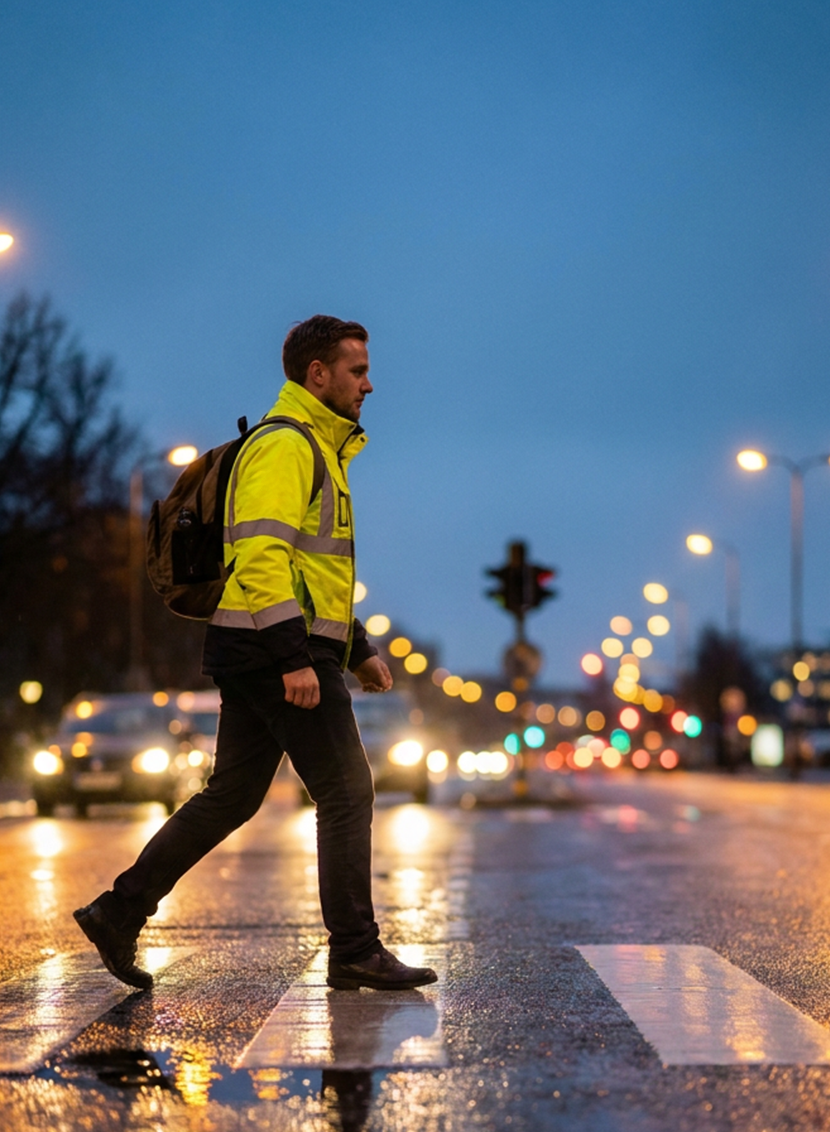
The safety of people at crossings and pedestrian crossings remains one of the great challenges in planning public space. In poorly lit environments, the risk of being hit by a vehicle rises considerably, especially on urban roads with heavy traffic or on secondary roads where vehicles travel faster. The problem lies in something as simple as it is critical: the driver does not see the pedestrian in time.
This challenge, common to every city and municipality, has driven the lighting industry to seek specific solutions that complement conventional road lighting. At Salvi we wanted to go a step further in this field by developing an optic designed exclusively for pedestrian crossings: Safepass.
Regulations and frame of reference
In Spain, the Regulation on energy efficiency in outdoor lighting installations (RD 1890/2008) includes a specific section on the lighting of pedestrian crossings. However, its scope is limited: it devotes only a short paragraph to defining the basic requirements.
At European level, various working groups have focused on this weak point in road safety. Although there is still no mandatory EU regulation, new lighting classes have already been proposed that set illuminance and uniformity levels in line with the type of road. This corrects one of the main problems of the national framework: the strong contrasts between the pedestrian crossing and the carriageway, which can confuse drivers rather than help them perceive pedestrians.
In our projects department we have adopted these guidelines as a design reference, getting ahead of regulatory developments and ensuring the solution meets the most demanding safety standards.
An optic designed from scratch
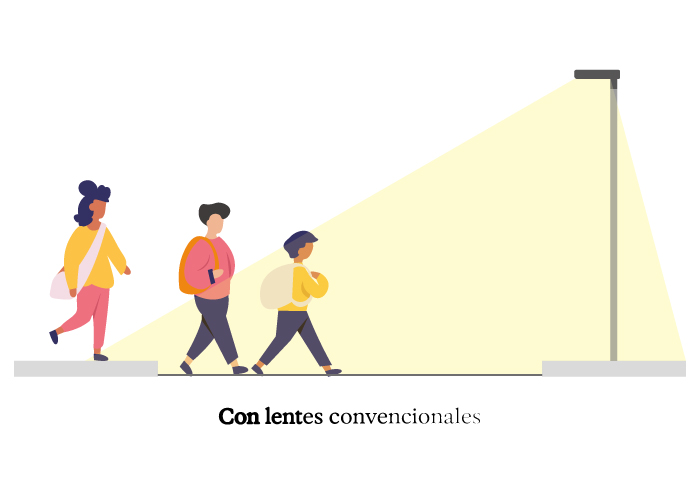
Most current lighting systems are born from adapting generic optics to different urban environments. In the case of pedestrian crossings, however, the solution had to be different.
Our Safepass proposal is based on an optic developed specifically for this use, with the aim of increasing pedestrian visibility and avoiding glare for drivers. The key lies in the photometric distribution:
- Horizontal plane: ensures minimum illuminance and uniformity levels on the surface of the crossing.
- Vertical plane: ensures the pedestrian's full figure is clearly visible from the vehicle's perspective, whatever its speed.
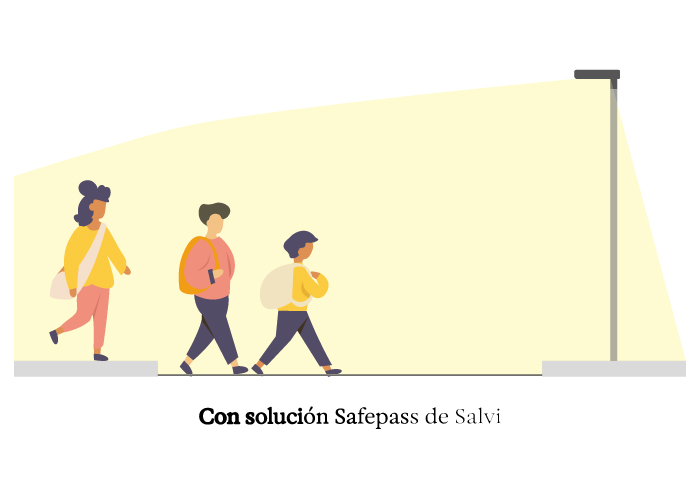
In this way, not only the ground is lit, but also the pedestrian's body, allowing faster and more accurate identification.
The uniformity of the whole is achieved by combining the new Safepass lens with the strategic placement of light points according to the direction of traffic.
Versatile application
The solution has been designed with the flexibility to adapt to different scenarios:
- Urban settings, with mounting heights between 4 and 6 metres.
- Roads, with heights of up to 10 metres.
This makes it ideal both for school or residential areas, where pedestrians are more vulnerable, and for fast-moving roads in peri-urban areas.
Energy efficiency and sustainability
Although installation and maintenance do not differ from other conventional solutions, there is a clear benefit in terms of efficiency: the lens directs light exclusively to critical areas —the pedestrian crossing and adjacent pavements— avoiding losses in irrelevant areas.
Its service life is equivalent to that of other Salvi luminaires, guaranteeing reliability and sustainability over time. On top of this, more precise lighting reduces light pollution and the associated energy consumption.
Road safety: beyond the data
At present there are no specific statistics measuring the impact of this optic on reducing accidents. However, the technical logic is clear: by improving the perception of pedestrians in the vertical plane, drivers have more reaction time and, therefore, the risk of hitting a pedestrian decreases.
This principle, backed by European working groups and by experience in road lighting projects, makes this solution a strategic ally for municipal road safety policies.
Towards the first installations
The Safepass solution is in its launch phase. The first installation projects are under way and field results will be shared soon. This stage will make it possible to gather feedback from local authorities, engineering firms and users, an essential step in validating in practice the benefits already seen in the design.
Conclusion
Safe mobility does not depend only on road infrastructure or awareness campaigns, but also on technical solutions that reduce the margin for human error. Pedestrian crossing lighting is a good example: a seemingly minor detail that can make the difference between seeing or not seeing a person crossing the street.
With Safepass, this new optic, Salvi puts technology at the service of public safety, offering municipalities a concrete tool to protect their pedestrians and move towards safer, more sustainable urban environments.