

Keys to success in tunnel lighting projects
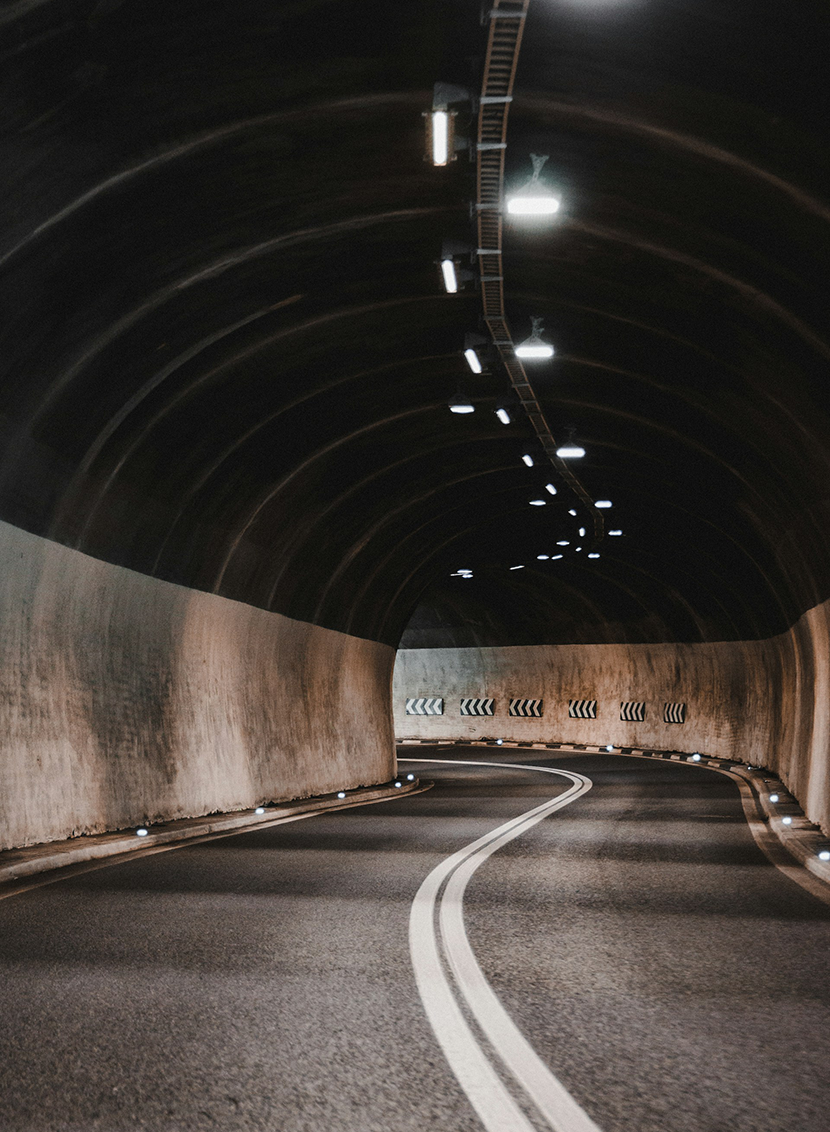
Developing a tunnel lighting project presents unique challenges that require meticulous planning and precise execution. The lack of natural light inside the tunnel must be offset with high-efficiency lighting to avoid the dangerous “black hole” effect and gradually adapt drivers from high outdoor lighting levels to dimmer lighting in the central part of the tunnel.
This type of project involves a series of key considerations and steps to guarantee the safety, efficiency and durability of the installation. In this guide, we highlight the most important aspects to consider for a successful installation, based on our experience at Salvi Lighting Barcelona.
Difference in light between the outside and inside of the tunnel.
The first thing to bear in mind when starting a tunnel lighting project is that the tunnel must be lit for two different scenarios: day and night. This is the most important aspect to consider first, since drivers' vision on entering the tunnel will be very different during the day and at night, and depending on whether the surroundings are an open road or not.
During the day, in open surroundings, drivers enter the tunnel with their eyes accustomed to very high natural light levels, and entering the tunnel can blind them if it is not well lit.
For this reason, tunnels are divided into zones that help plan the lighting project:
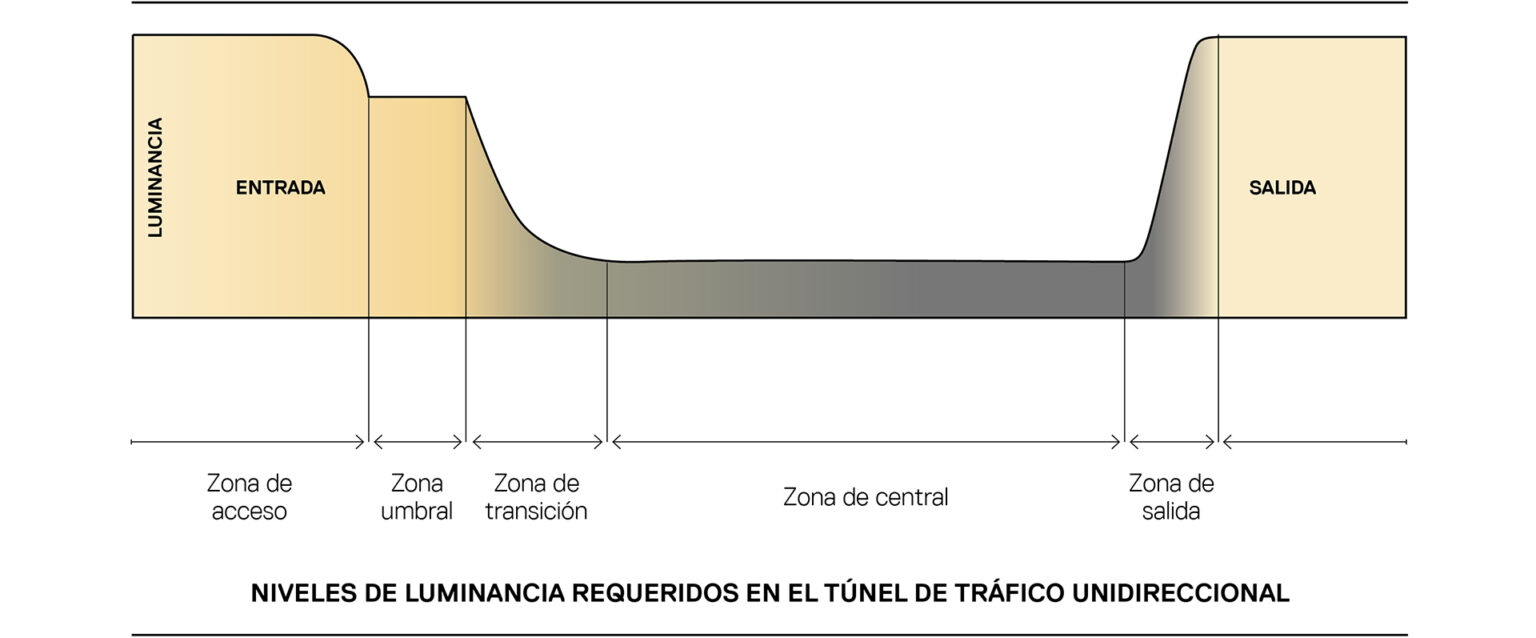
Access zone:
– Outdoor lighting: in this zone, a smooth transition must be ensured from natural outdoor light to the inside of the tunnel. Lighting must be gradual to avoid the “black hole” effect.
Threshold zone:
– Adaptation lighting: this zone is critical, since the human eye needs time to adapt to the light level inside the tunnel. Light must be intense and well distributed to guarantee clear, safe visibility.
Transition zone:
– Gradual lighting: lighting in this zone must decrease gradually to help drivers' eyes adapt to the lower light levels inside the tunnel.
Interior zone:
– Constant, uniform lighting: light intensity can be lower than in the previous zones, but must be sufficient to ensure clear visibility along the whole length of the tunnel.
Exit zone:
– Adaptation lighting for the exit: as vehicles approach the tunnel exit, lighting must increase gradually to prepare drivers for the outdoor light.
Safety regulations and standards in tunnel lighting.
There is extensive international regulation covering every aspect of the lighting field. For tunnel lighting, these standards define, among other parameters, the minimum lighting levels needed to ensure drivers' visibility and safety.
It is crucial to comply with international and local regulations and standards on tunnel lighting, both to guarantee public safety and the success of the project and to generate savings in initial investment and long-term maintenance costs.
The UNE-EN 13201 standard, for example, sets out the requirements for tunnel and road lighting.
Main stakeholders in a tunnel lighting project.
Every tunnel lighting project involves three main stakeholders: the owner, the engineering firm and the installer or maintenance contractor. Each has specific objectives that must be taken into account to achieve an efficient, functional installation.
- Owner: seeks to minimise investment and operating costs, and expects the installation to run smoothly in the long term.
- Engineering firm: must comply with regulations, guarantee visual comfort and keep the project within budget.
- Installer/Maintenance contractor: needs to reduce assembly times, minimise problems during the works and ensure peace of mind after installation.
- Manufacturer: must listen to and take into account the needs of all stakeholders, as well as the particularities of the location, to offer the most suitable solution.
Objectives translated into specifications
Each stakeholder's objectives can be translated into a series of key technical concepts:
- Durability and robustness: ensure that luminaires and systems are resistant and long-lasting.
- Luminaire efficiency (lm/W): maximise energy efficiency.
- Photometry and uniformity: guarantee uniform lighting suitable for road safety.
- Controlled glare: minimise glare for drivers' comfort.
- Support and after-sales service: provide excellent service and technical support.
Choosing the right luminaires
In tunnel lighting, the durability and robustness of luminaires are fundamental.
Components and configurations make the difference. Luminaires and systems must withstand harsh conditions, including constant vibration caused by traffic, high humidity and possible contaminants in the tunnel environment. This not only ensures a long service life for the equipment, reducing the frequency of maintenance and replacement, but also contributes to road safety by guaranteeing constant, reliable lighting. Using corrosion-resistant materials and designs that protect against mechanical impact are practices that increase the durability and robustness of installations.
Selecting the right product is crucial. At Salvi Lighting, we offer floodlights with advanced features:
- Efficiency (182.2 lm/W).
- Glare control and easy access for maintenance.
- Flexibility in sizes and configurations for different scenarios.
- Sealing: resistance to dust and protection against microparticles, splashes and violent impacts.
- Anti-corrosion.
- Heat dissipation: ensuring correct operation in extreme conditions.
- Fire resistance: non-flammable materials.
Luminaire efficiency (lm/W)
Maximising energy efficiency in tunnel lighting is crucial from both an economic and an environmental perspective. Luminaire efficiency, measured in lumens per watt (lm/W), indicates how much light is produced per unit of energy consumed. High efficiency reduces energy consumption and, therefore, operating costs. In addition, lower energy demand helps reduce the project's carbon footprint. In large-scale projects such as tunnels, even small improvements in energy efficiency can translate into significant financial and environmental savings.
Adaptability and photometry
Adaptability and photometric precision are essential in tunnel lighting projects due to the diversity of configurations and the specific requirements of each type of tunnel.
Types of tunnels
- One-way and two-way: the direction of traffic affects the placement and type of luminaires required. In one-way tunnels, lighting must focus on the direction of traffic, while in two-way tunnels it must take traffic in both directions into account.
- Varied mounting heights: depending on the height of the tunnel, luminaires must be adjusted to provide adequate lighting without causing glare. Mounting height influences light distribution and the number of luminaires needed to maintain uniformity.
- Luminaire positions: luminaires can be arranged in different configurations, such as one-sided, two-sided, central or counter-beam. Each configuration requires a specific photometric approach to ensure uniform light distribution and avoid shadows or poorly lit areas.
Development of specific lenses
- Lenses optimised for different scenarios: to maximise efficiency in each scenario, specific lenses are developed to adapt light emission to the tunnel's needs. These lenses direct light exactly where it is needed, improving visibility and reducing energy consumption.
- Maximising luminous efficiency: custom-designed lenses ensure that light is distributed uniformly, optimising the spacing between luminaires and minimising glare. This not only improves road safety, but also contributes to the project's sustainability by reducing the number of luminaires needed and, therefore, energy consumption.
Photometry
- Uniform light distribution: proper photometry ensures light is distributed uniformly along the tunnel, eliminating dark areas and providing constant visibility for drivers. This is crucial for safety, especially in long tunnels or those with sharp bends.
- Glare reduction: precise photometric design minimises glare, which can be dangerous for drivers. Luminaires must be equipped with glare control technology to ensure a comfortable, safe visual environment.
Selection and optimisation process
When choosing the right photometry for tunnel lighting, it is important to use specific software such as ReluxTunnel to take internal reflections into account and follow the profile of the CIE 88 adaptation curve.
This ensures a smooth transition in lighting levels inside the tunnel, guaranteeing visual comfort and safety.
Direct replacement vs. optimisation
Two possible approaches are the direct replacement of existing luminaires or complete optimisation:
- Direct replacement: lower initial investment and shorter installation times, but may not maximise energy savings.
- Complete optimisation: higher initial investment, but with significant reductions in installed power and long-term energy consumption.
Case study: tunnel lighting project in northern Spain
In a real tunnel lighting project, we evaluated both options for a tunnel 10 metres wide with luminaires mounted at 4.65 metres. The optimised version resulted in a 20% saving in installed power and 19.2% in energy savings, without sacrificing user comfort.
Smart lighting management technologies
Smart lighting control systems
Implementing smart control systems makes it possible to adjust lighting in real time according to traffic conditions and natural light. This not only improves energy efficiency but also adapts lighting to the tunnel's immediate needs.
Predictive maintenance
Advanced technology makes it possible to monitor luminaire performance and predict failures before they occur, ensuring efficient maintenance and reducing downtime.
Smartec® Lighting
Smartec® Lighting is a high-performance wireless communication system. Combining the latest cutting-edge IoT technologies, reliability and flexibility, it is defined as a point-to-point smart lighting system that works with wireless nodes connecting individual luminaires through a long-range network and a Central Management System (CMS).
Conclusion
To conclude, collaboration between the owner, the engineering firm and the installer, together with the equipment supplier, is essential to achieve an efficient, long-lasting installation. Choosing the right product, adapting to different scenarios and pursuing excellence in installation are key to the success of any tunnel lighting project.
At Salvi Lighting, we are committed to offering lighting solutions that not only meet the highest standards of safety and efficiency, but also contribute to the sustainable development of road infrastructure. We hope these points are useful for your next tunnel lighting project!