

Keys to optimising public lighting with solar luminaire systems
The importance of planning in solar luminaire projects
At a time when we need to find ever more sustainable and environmentally friendly solutions, solar technology has become a beacon of hope, including for the public lighting sector.
The adoption of solar luminaires is a step towards reducing the carbon footprint and a boost towards energy independence and long-term efficiency.
The most obvious advantage of solar luminaires lies in their ability to harness an inexhaustible, clean energy source: the sun. This approach not only reduces long-term operating costs, but also guarantees a reliable energy supply even in remote areas or those with limited access to the power grid.
However, many solar lighting projects implemented around the world do not become success stories or achieve their intended goals. This can be due to several reasons, including inadequate project design and a poor energy balance, low product quality, the lack of a diagnostic system, lack of maintenance and vandalism. The result is an investment lost in a short time.
What factors should be taken into account when planning a solar luminaire project?
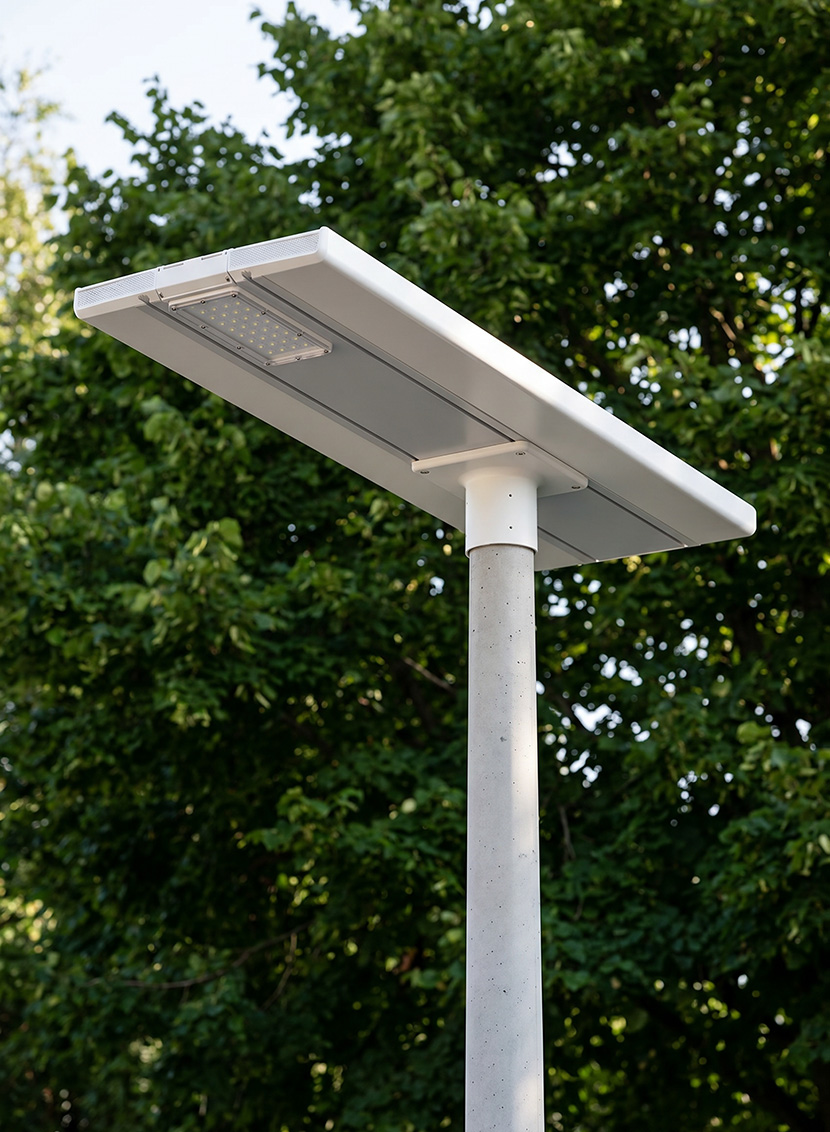
A solar luminaire has three elements: the photovoltaic panel, the battery and the luminaire. But when talking about solar lighting, the essential thing is to understand that the luminaire will only have the energy captured by the panel and stored in the batteries, and that there must be a balance between the luminaire's consumption and the stored energy (Wh).
To achieve this, and with the aim of obtaining maximum lighting, the luminaire and the lighting project must be as efficient as possible in terms of lm/W.
It will also be necessary to adapt light levels to different times and needs, so that energy is saved whenever lighting levels can be lowered.
The success of a solar project depends on the following parameters:
- Project location and application.
- Panel sizing.
- Battery sizing.
- Luminaire consumption strategies.
- Correct interpretation of the information on each of these attributes and of the studies carried out before the project is executed.
That is why the first question we ask ourselves at Salvi Lighting when we receive a solar lighting project is: what are the project's conditions and needs?
The first step is to know how much energy is available, defined by the panel power (W) and the battery capacity (Wh) in a given geographical location. It is also important to consider battery life, which depends on its technology, the temperature and the maximum permitted discharge percentage. At Salvi we currently use LiFePO4 + graphene technology, which allows us to offer a life of around 5,000 cycles (more than ten years in public lighting).
With all the information, we carry out a lighting study that determines the power required for the maximum lighting condition. We study the energy balance, which consists of multiplying the power consumed by the time of use and adding it up for the different periods of the night with different lighting intensities, and then comparing it with the energy available in the battery.
Several iterations are usually needed, varying the required power, levels and times of use until balance is achieved.
Our luminaire configurator is an easy-to-use online tool designed to guide our clients through the process of customising their project quickly and easily. This tool performs photometric calculations, solar configuration and complete product definition and, as a result, presents all the necessary project documentation.
For solar luminaire projects, this configurator allows us to determine the solar feasibility of the project and provide documentation such as the feasibility report, the product data sheet, drawings and lighting studies.
The solar radiation reaching the panel is a decisive factor in correctly sizing the requirements according to geographical location.
During the analysis and planning stage of each solar lighting project, we use tools that provide detailed, accurate information on solar radiation and the performance of photovoltaic systems in a specific location. They also help us size panels and batteries to plan and develop solar projects.
A well-designed public lighting system improves road safety and contributes to environmental protection by reducing light pollution and energy consumption. The right choice and configuration of the luminaire are essential to achieve optimal energy efficiency and use material and energy resources consistently.
The Smartec® remote monitoring and control tool monitors in real time all the parameters of the luminaire, the battery, the solar panel and the operating mode throughout the night and across the seasons of the year, and allows them to be adjusted remotely if necessary.
It is a vital element for the success of the project and the durability of the solar luminaire for many years, making preventive and corrective maintenance of lighting installations easier.